









KETIDAKPASTIAN EKONOMI TERHADAP STABILITAS BANK DI INDONESIA
Abstract
The research measures the economic uncertainty variable using World Uncertainty Index (WUI) and uses three proxies of bank risk (bank default risk, bank leverage risk, and bank portfolio risk) to assess its becoming effect on the stability of Indonesia banks. In an analysis based on panel data and a combination of fixed and random effects models, the study aims to reflect how world economic uncertainty influences bank stability in Indonesia. The results however indicate that economic uncertainty shows no influence towards all bank risk aspects, which consists of default risk, leverage risk, and portfolio risk, based on the 5 percent significance level. This result implies that Indonesian banks are generally quite resistant from the direct impact of economic uncertainty relating to credit default risk, leverage risk, and portfolio risk. This research paper also takes into consideration the structural characteristics of banks that would be important predictors of this bank stability risk in these dimensions, namely, loan share, income diversification, liquidity and commission-based income.
Keywords : Bank Stability, Economic Uncertainty, Financial Resilience, World Uncertainty Index (WUI)Full Text:
PDFReferences
Ahir, H., Bloom, N., & Furceri, D. (2020). Years of Uncertainty. Finance & Development.
Al‐Thaqeb, S. A., Algharabali, B. G., & Alabdulghafour, K. T. (2020). The pandemic and economic policy uncertainty. International Journal of Finance & Economics, 27(3), 2784–2794. https://doi.org/10.1002/ijfe.2298
Armanious, A., & Zhao, R. (2024). Stock liquidity effect on leverage: The role of debt security, financial constraint, and risk around the global financial crisis and Covid-19 pandemic. International Review of Financial Analysis, 92, 103093. https://doi.org/10.1016/j.irfa.2024.103093
Ashraf, B. N. (2021). Is economic uncertainty a risk factor in bank loan pricing decisions? International evidence. Risks, 9(5), 81. https://doi.org/10.3390/risks9050081
Baker, S.R., Bloom, N., Davis, S.J., 2016. Measuring economic policy uncertainty. Q. J. Econ. 131 (4), 1593–1636.
Baum, C. F., Caglayan, M., & Xu, B. (2020). The impact of uncertainty on financial institutions: A cross‐country study. International Journal of Finance & Economics, 26(3), 3719–3739. https://doi.org/10.1002/ijfe.1983
Beers, B. (2022). The Dangers of Over-Diversifying your portfolio. Investopedia. https://www.investopedia.com/investing/dangers-over-diversifying-your-portfolio/
Berrospide, J. M. (2021). Bank liquidity hoarding and the Financial Crisis: An Empirical evaluation. Quarterly Journal of Finance, 11(04). https://doi.org/10.1142/s2010139221500208
Bilgin, M. H., Danisman, G. O., Demir, E., & Tarazi, A. (2021). Economic uncertainty and bank stability: Conventional vs. Islamic banking. Journal of Financial Stability, 56, 100911. https://doi.org/10.1016/j.jfs.2021.100911
Calcagnini, G., Gardini, L., Giombini, G., & Carrera, E. S. (2020). Does too much liquidity generate instability? Journal of Economic Interaction and Coordination,
Dang, T. H., Nguyen, C. P., Lee, G. S., Nguyen, B. Q., & Le, T. T. (2023). Measuring the energy-related uncertainty index. Energy Economics, 124, 106817. https://doi.org/10.1016/j.eneco.2023.106817
Dominic, J., Joseph, A., & Sisodia, G. (2023). The Role of the Banking Sector in Economic Resurgence and Resilience: Evidence from Pacific Island Countries. Global Journal of Flexible Systems Management, 24(S1), 9–30. https://doi.org/10.1007/s40171-023-00370
Dungey, M., Luciani, M., & Veredas, D. (2023). Ranking systemically important financial institutions. Figshare. https://figshare.utas.edu.au/articles/report/Ranking_systemically_important_financial_institutions/23438759/1
Guerra-Leal, E. M., Arredondo-Trapero, F. G., & Vázquez-Parra, J. C. (2021). Financial inclusion and digital banking on an emergent economy. Review of Behavioral Finance, 15(2), 257–272. https://doi.org/10.1108/rbf-08-2021-0150
Jomo, K. S., & Chowdhury, A. (2020). COVID-19 pandemic recession and recovery. Development, 63(2–4), 226–237. https://doi.org/10.1057/s41301-020-00262-0
Kesraoui, A., Lachaab, M., & Omri, A. (2022). The impact of credit risk and liquidity risk on bank margins during economic fluctuations: evidence from MENA countries with a dual banking system. Applied Economics, 54(35), 4113–4130. https://doi.org/10.1080/00036846.2021.2022090
Majiid, F. A. (2023). Economic crisis and institutional transformation : comparative analysis of Indonesia 1998 and Greece 2009. Cadmus EUI. https://doi.org/10.2870/6528304
Marcelin, I., Egbendewe, A. Y., Oloufade, D. K., & Sun, W. (2021). Financial inclusion, bank ownership, and economy performance: Evidence from developing countries. Finance Research Letters, 46, 102322. https://doi.org/10.1016/j.frl.2021.102322
Martinez, J. (2023). Financial risk management in international markets. http://cmsr.info/index.php/Journal/article/view/28
Naili, M., & Lahrichi, Y. (2020). The determinants of banks’ credit risk: Review of the literature and future research agenda. International Journal of Finance & Economics, 27(1), 334–360. https://doi.org/10.1002/ijfe.2156
Oino, I. (2021). Bank solvency: The role of credit and liquidity risks, regulatory capital and economic stability. Banks and Bank Systems, 16(4), 84–100. https://doi.org/10.21511/bbs.16(4).2021.08
Otoritas Jasa Keuangan. (2023, May 5). The resilience of the financial sector maintained amidst ongoing global uncertainties. https://ojk.go.id/en/berita-dan-kegiatan/siaran-pers/Pages/The-Resilience-of-the-Financial-Sector-Maintained-amidst-Ongoing-Global-Uncertainties.aspx
Omri, M. B. (2022, March 1). Understanding the relationship between liquidity and banking financial stability in Islamic and conventional banks. http://resdojournals.com/index.php/jbeo/article/view/206
Pham, H. S. T., Le, T., & Nguyen, L. Q. T. (2021). Monetary Policy and bank liquidity creation: Does bank size matter? International Economic Journal, 35(2), 205–222. https://doi.org/10.1080/10168737.2021.1901762
Phan, D. H. B., Iyke, B. N., Sharma, S. S., & Affandi, Y. (2020). Economic policy uncertainty and financial stability–Is there a relation? Economic Modelling, 94, 1018–1029. https://doi.org/10.1016/j.econmod.2020.02.042
Ratnawati, K. (2020). The impact of financial inclusion on economic growth, poverty, income inequality, and financial stability in Asia. Journal of Asian Finance Economics and Business, 7(10), 73–85. https://doi.org/10.13106/jafeb.2020.vol7.no10.073
Shabir, M., Jiang, P., Wang, W., & Işık, Ö. (2023). COVID-19 pandemic impact on banking sector: A cross-country analysis. Journal of Multinational Financial Management, 67, 100784. https://doi.org/10.1016/j.mulfin.2023.100784
Siregar, R. Y., Gunawan, A. H., & Saputro, A. N. (2021). Impact of the COVID-19 shock on banking and corporate sector vulnerabilities in Indonesia. Bulletin of Indonesian Economic Studies, 57(2), 147–173. https://doi.org/10.1080/00074918.2021.1956397
Wibowo, A. (2023). Global Economic Challenges for Indonesia: Equitable Development for Sustainable Prosperity. proceedings.goodwoodconferences.com. https://doi.org/10.35912/stabek.v3i.175
Wu, J., Yao, Y., Chen, M., & Jeon, B. N. (2020). Economic uncertainty and bank risk: Evidence from emerging economies. Journal of International Financial Markets Institutions and Money, 68, 101242. https://doi.org/10.1016/j.intfin.2020.101242
Wu, J., Yao, Y., Chen, M., & Jeon, B. N. (2021). Does economic uncertainty affect the soundness of banks? Evidence from emerging Asian economies. Journal of Asian Economics, 77, 101394. https://doi.org/10.1016/j.asieco.2021.101394
Wu, S. W., Nguyen, M. T., & Nguyen, P. H. (2022). Does loan growth impact on bank risk? Heliyon, 8(8), e10319. https://doi.org/10.1016/j.heliyon.2022.e10319
Wullweber, J. (2020). The COVID-19 financial crisis, global financial instabilities and transformations in the financial system. SSRN Electronic Journal. https://doi.org/10.2139/ssrn.3688453
DOI: https://doi.org/10.71312/mrbest.v4i2.642
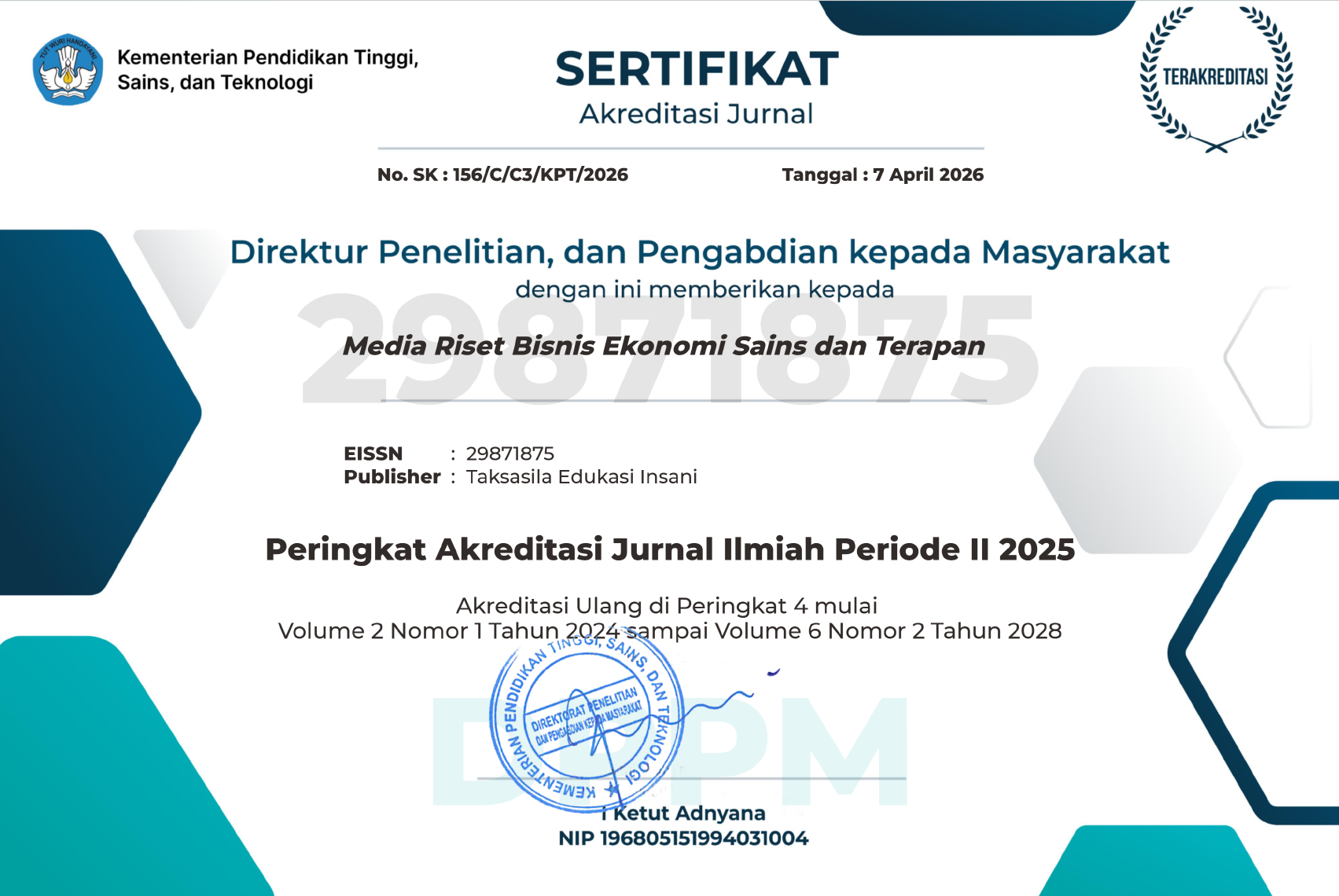
Media Riset Bisnis Ekonomi Sains dan Terapan (MRBEST) Indexed by:




Publisher: Taksasila Edukasi Insani
Contact: Tri Ananto
Publisher Address: Jl. Cireundeu Raya No.1A, RT.002/RW.06, Kelurahan Cireundeu, Kecamatan Ciputat Timur, Kota Tangerang Selatan, Banten 15419.
Copyright © 2023 Media Riset Bisnis Ekonomi Sains dan Terapan (e-ISSN: 2987-1875)



Media Riset Bisnis Ekonomi Sains dan Terapan © 2023 by Taksasila Edukasi Insani is licensed under Creative Commons Attribution-ShareAlike 4.0 International.