









KUALITAS LAYANAN AI TOOLS DAN RELIGIUSITAS: DAMPAK TERHADAP NIAT PEMBELIAN ONLINE SHOPPING PADA KONSUMEN MUSLIM
Abstract
This study examines the impact of AI Tools service quality, represented by response accuracy, consistency, and technology quality, on online shopping purchase intention among Muslim consumers, with religiosity serving as a moderating variable. The increasing adoption of artificial intelligence in e-commerce has enhanced customer service and shopping experiences; however, limited research has explored its effectiveness in influencing purchase intention among Muslim consumers. This study employed a quantitative approach using a survey of 100 Muslim consumers in the Greater Jakarta area (Jabodetabek), Indonesia. Data were collected through an online questionnaire and analyzed using Partial Least Squares Structural Equation Modeling (PLS-SEM). The results indicate that response accuracy has a positive and significant effect on purchase intention, while consistency and technology quality do not significantly influence purchase intention. Furthermore, religiosity does not moderate the relationships between response accuracy, consistency, technology quality, and purchase intention. These findings suggest that Muslim consumers place greater emphasis on the accuracy and relevance of information provided by AI Tools than on technological sophistication or personal religiosity when making online purchasing decisions.
Keywords: AI Tools Service Quality, Muslim Consumers, Online Shopping, Purchase Intention, Religiosity
Full Text:
PDFReferences
Abdou, A. H., Chan, M. P., Rehman, S. U., Albakhit, A. I. A., & Almakhayitah, M. Y. (2024). Islamic food laws: customer satisfaction effect halal purchase intention in China. Moderating role of religiosity. British Food Journal, 126(8), 3088–3112. https://doi.org/10.1108/BFJ-10-2023-0875
Adam, M., Wessel, M., & Benlian, A. (2021). AI-based chatbots in customer service and their effects on user compliance. Electronic Markets, 31(2), 427–445. https://doi.org/10.1007/s12525-020-00414-7
Akdemir, D. M., & Bulut, Z. A. (2024). Business and Customer-Based Chatbot Activities: The Role of Customer Satisfaction in Online Purchase Intention and Intention to Reuse Chatbots. In Journal of Theoretical and Applied Electronic Commerce Research (Vol. 19, Issue 4, pp. 2961–2979). https://doi.org/10.3390/jtaer19040142
Al-Adwan, A. S., Al-Debei, M. M., & Dwivedi, Y. K. (2022). E-commerce in high uncertainty avoidance cultures: The driving forces of repurchase and word-of-mouth intentions. Technology in Society, 71, 102083. https://doi.org/https://doi.org/10.1016/j.techsoc.2022.102083
Al Arif, M. N. A., & Mubarok, F. (2022). Metode Riset Pada Ekonomi dan Bisnis. Pustaka Setia Bandung.
Amalia, F. A., Sosianika, A., & Suhartanto, D. (2020). Indonesian Millennials’ Halal food purchasing: merely a habit? British Food Journal, 122(4), 1185–1198. https://doi.org/10.1108/BFJ-10-2019-0748
Armutcu, B. (2026). The effects of AI-powered chatbot communication quality on consumer purchase intention: the mediating role of brand elements and consumer–brand relationships. Journal of Enterprise Information Management, 1–29. https://doi.org/10.1108/JEIM-10-2025-1081
Arsawan, I. W. E., Koval, V., Suhrtanto, D., Hariyanti, N. K. D., Polishchuk, N., & Bondar, V. (2024). Circular economy practices in SMEs : aligning model of green economic incentives and environmental commitment. International Journal of Productivity and Performance Management, 73(3), 775–793. https://doi.org/10.1108/IJPPM-03-2022-0144
Atkinson, R. C., & Shiffrin, R. M. (1968). Human Memory: A Proposed System and its Control Processes. In K. W. Spence & J. T. B. T.-P. of L. and M. Spence (Eds.), Psychology of Learning and Motivation (Vol. 2, pp. 89–195). Academic Press. https://doi.org/https://doi.org/10.1016/S0079-7421(08)60422-3
Baek, C. H., Kim, S.-Y., Lim, S. U., & Xiong, J. (2023). Quality evaluation model of artificial intelligence service for startups. International Journal of Entrepreneurial Behavior & Research, 29(4), 913–940. https://doi.org/10.1108/IJEBR-03-2021-0223
Chau, H. K. L., Ngo, T. T. A., Bui, C. T., & Tran, N. P. N. (2025). Human-AI interaction in E-Commerce: The impact of AI-powered customer service on user experience and decision-making. Computers in Human Behavior Reports, 19, 100725. https://doi.org/https://doi.org/10.1016/j.chbr.2025.100725
Chen, Q., Lu, Y., Gong, Y., & Xiong, J. (2023). Can AI chatbots help retain customers? Impact of AI service quality on customer loyalty. Internet Research, 33(6), 2205–2243. https://doi.org/10.1108/INTR-09-2021-0686
Chen, S., Li, X., Liu, K., & Wang, X. (2023). Chatbot or human? The impact of online customer service on consumers’ purchase intentions. Psychology & Marketing, 40(11), 2186–2200. https://doi.org/https://doi.org/10.1002/mar.21862
Chen, S., Wang, P., & Wood, J. (2025). Exploring the varying effects of chatbot service quality dimensions on customer intentions to switch service agents. Scientific Reports, 15(1), 22559. https://doi.org/10.1038/s41598-025-06490-z
Crishtiawan, D. G., Yuliana, R., & Terasa, I. N. (2025). Membongkar Pilihan Gen Z: Bagaimana Kualitas, Kesadaran Kesehatan, dan Harga Menentukan Kepuasan Pada Makanan Tradisional. Jurnal Capital: Kebijakan Ekonomi, Manajemen & Akuntansi, 7(2), 187–200.
Dey, C. (2026). Understanding the influence of AI-driven personalized recommendations on consumer buying behavior in halal marketing. Journal of Islamic Marketing, 1–21. https://doi.org/10.1108/JIMA-05-2025-0311
Faizin, N., Alfan, M., Basid, A., Ramadhan, M. R., Panatik, S. A., & Kawakip, A. N. (2025). Muslim students’ acceptance of artificial intelligence in Islamic religious education: an extended TAM approach. Discover Education, 4(1), 304. https://doi.org/10.1007/s44217-025-00767-1
Ghosh, S., Ness, S., & Salunkhe, S. (2024). The Role of AI Enabled Chatbots in Omnichannel Customer Service. Journal of Engineering Research and Reports, 26(6), 327–345. https://doi.org/https://doi.org/10.9734/jerr/2024/v26i61184
Goutam, D., Ganguli, S., & Gopalakrishna, B. V. (2022). Technology readiness and e-service quality – impact on purchase intention and loyalty. Marketing Intelligence & Planning, 40(2), 242–255. https://doi.org/10.1108/MIP-06-2021-0196
Guo, Bingxuan, & Wang, Dian. (2024). Will Online Shopping Lead to More Brand Loyalty Than Offline Shopping? The Role of Uncertainty Avoidance. Journal of Marketing Research, 61(1), 92–109. https://doi.org/10.1177/00222437231153075
Hair, J. F., Hult, G. T. M., Ringle, C. M., & Sarstedt, M. (2017). A Primer on Partial Least Squares Structural Equation Modeling (PLS-SEM) (2nd ed.). SAGE Publications Inc.
Hair, J. F., Hult, G. T. M., Ringle, C. M., & Sarstedt, M. (2022). A Primer on Partial Least Squares Structural Equation Modeling (PLS-SEM) (3rd ed.). SAGE Publications Inc.
Horáková, J., & Uusitalo, O. (2026). Brick-and-mortar and E-commerce. In The Wiley Blackwell Companion to the City, Retail, and Consumption (pp. 395–412). https://doi.org/https://doi.org/10.1002/9781394278657.ch22
Hsu, C.-L., & Lin, J. C.-C. (2023). Understanding the user satisfaction and loyalty of customer service chatbots. Journal of Retailing and Consumer Services, 71, 103211. https://doi.org/https://doi.org/10.1016/j.jretconser.2022.103211
Huang, S. Y. B. (2026). Asking fintech voice Chatbots: Explaining consumer switching intention by status quo bias theory. Journal of Retailing and Consumer Services, 88, 104457. https://doi.org/https://doi.org/10.1016/j.jretconser.2025.104457
Jafari, Aliakbar, & Süerdem, Ahmet. (2012). An analysis of material consumption culture in the Muslim world. Marketing Theory, 12(1), 61–79. https://doi.org/10.1177/1470593111424184
Kaur, J., Bhardwaj, N., Fernandes, R., Vidya, V., & Farooqui, N. A. (2022). A meta-analytical study on the role of religiosity on purchase intention in the theory of planned behavior. Journal of Islamic Marketing, 14(11), 2845–2870. https://doi.org/10.1108/JIMA-09-2021-0304
Khan, A., Arafat, M. Y., & Azam, M. K. (2022). Role of halal literacy and religiosity in buying intention of halal branded food products in India. Journal of Islamic Marketing, 13(2), 287–308. https://doi.org/10.1108/JIMA-08-2019-0175
Khokhar, S., Shahid, M., Hafeez, S., & Tufail, M. S. (2022). The effect of perceived financial risk on purchase intention in Pakistan. International Journal of Emerging Markets, 19(6), 1473–1491. https://doi.org/10.1108/IJOEM-01-2022-0001
Koc, F., Ozkan, B., Komodromos, M., Halil Efendioglu, I., & Baran, T. (2025). The effects of trust and religiosity on halal products purchase intention: indirect effect of attitude. EuroMed Journal of Business, 20(5), 141–165. https://doi.org/10.1108/EMJB-01-2024-0004
Lei, G., & Yuanfeng, C. (2024). An analysis of the Impact of Text-based AI Chatbot on Consumer Purchase Intentions in Online Shopping Platforms. International Journal of Sociologies and Anthropologies Science Reviews, 4(6), 399–416. https://doi.org/https://doi.org/10.60027/ijsasr.2024.4970
Li, S., Peng, G., Xing, F., Zhang, J., & Zhang, B. (2021). Value co-creation in industrial AI: The interactive role of B2B supplier, customer and technology provider. Industrial Marketing Management, 98, 105–114. https://doi.org/https://doi.org/10.1016/j.indmarman.2021.07.015
Ling, T., Zhao, R., & Jang, H. (2024). Psychological need profiles during online shopping: exploring associations with word-of-mouth and loyalty. Asia Pacific Journal of Marketing and Logistics, 36(12), 3553–3570. https://doi.org/10.1108/APJML-02-2024-0223
Lu, C.-H., Li, C.-Y., & Chen, Y.-X. (2026). How does a service chatbot build parasocial relationships with customers? A perspective from parasocial interaction theory. Internet Research, 36(7), 107–126. https://doi.org/10.1108/INTR-03-2024-0421
Lu, Z., Min, Q., Jiang, L., & Chen, Q. (2024). The effect of the anthropomorphic design of chatbots on customer switching intention when the chatbot service fails: An expectation perspective. International Journal of Information Management, 76, 102767. https://doi.org/https://doi.org/10.1016/j.ijinfomgt.2024.102767
Misischia, C. V., Poecze, F., & Strauss, C. (2022). Chatbots in customer service: Their relevance and impact on service quality. Procedia Computer Science, 201, 421–428. https://doi.org/https://doi.org/10.1016/j.procs.2022.03.055
Mustaffa, N. M., Nurul, M., Ibrahim, H., Camp, S. B., & Author, C. (2025). Technology and Access to Islamic Contents : The Acceptance of Islamic Digital Contents. International Journal of Research and Innovation in Social Sciences (IJRISS), IX(XX). https://doi.org/10.47772/IJRISS
Naeem, S., Lee, M. S. W., & Ayyub, R. M. (2025). Understanding the impact of religion on consumption: Is religiosity or religiocentrism more appropriate? Journal of Islamic Marketing, 17(1), 191–212. https://doi.org/10.1108/JIMA-11-2024-0551
Nga, L. P., & Tam, P. T. (2024). KEY FACTORS AFFECTING ONLINE SHOPPING ATTITUDE AND INTENTION : A CASE STUDY OF CONSUMERS IN VIETNAM. Journal of Eastern European and Central Asian Research, 11(1), 66–78. https://doi.org/https://doi.org/10.15549/jeecar.v11i1.1547
Pillai, R., Sivathanu, B., & Dwivedi, Y. K. (2020). Shopping intention at AI-powered automated retail stores (AIPARS). Journal of Retailing and Consumer Services, 57, 102207. https://doi.org/https://doi.org/10.1016/j.jretconser.2020.102207
Saoula, O., Shamim, A., Mohd Suki, N., Ahmad, M. J., Abid, M. F., Patwary, A. K., & Abbasi, A. Z. (2023). Building e-trust and e-retention in online shopping: the role of website design, reliability and perceived ease of use. Spanish Journal of Marketing - ESIC, 27(2), 178–201. https://doi.org/10.1108/SJME-07-2022-0159
Sekaran, U., & Bougie, R. (2016). Research Methods for Business: A Skill Building Approach (7th ed.). John Wiley & Sons, Ltd.
Septyandi, C. B., & Utomo, S. R. S. P. (2025). AI and Spiritual Compatibility : Examining Human- Technology Interaction in Gen-Z Muslim Pilgrimage. Journal of Tourism Sustainability, 5(2), 166–177. https://doi.org/10.35313/jtospolban.v5i2.183
Sharma, N., & Tandon, U. (2025). Who cares if it is rainy or sunny? Optimizing repurchase intention through weather and service quality of AI tools. Information Discovery and Delivery, 1–16. https://doi.org/10.1108/IDD-03-2025-0047
Sharma, N., & Tandon, U. (2026). Investigating AI-based service quality in online shopping: a dual lens of perceived value and need for cognition. Journal of Systems and Information Technology, 1–24. https://doi.org/10.1108/JSIT-06-2025-0261
Sholihin, M., Shalihin, N., Ilhamiwati, M., & Hendrianto, H. (2022). Maqasid-based consumption intelligence: an empirical model of its application to the intention of halal purchase. International Journal of Ethics and Systems, 39(2), 402–431. https://doi.org/10.1108/IJOES-11-2021-0204
Sinanović, E. (2012). Islamic Revival as Development: Discourses on Islam, Modernity, and Democracy since the 1950s. Politics, Religion & Ideology, 13(1), 3–24. https://doi.org/10.1080/21567689.2012.659500
Sovacool, B. K., Axsen, J., & Sorrell, S. (2018). Promoting novelty, rigor, and style in energy social science: Towards codes of practice for appropriate methods and research design. Energy Research & Social Science, 45, 12–42. https://doi.org/https://doi.org/10.1016/j.erss.2018.07.007
Suhartanto, D., Setiawan, S., & Safitri, F. M. (2026). AI-enabled brand experience and Shariah compliance in Islamic digital banking. Journal of Islamic Marketing, 1–20. https://doi.org/10.1108/JIMA-07-2025-0411
Supriani, I., Ninglasari, S. Y., & Iswati, S. (2024). How social media influencers form Muslim consumers’ halal cosmetics purchase intention: religiosity concern. Journal of Islamic Marketing, 16(2), 502–525. https://doi.org/10.1108/JIMA-02-2024-0085
Sutinen, U.-M., Saarijärvi, H., & Yrjölä, M. (2022). Shop at your own risk? Consumer activities in fashion e-commerce. International Journal of Consumer Studies, 46(4), 1299–1318. https://doi.org/https://doi.org/10.1111/ijcs.12759
Syam, A. H., Hafipah, H., Nuryadin, A., Nurmega, N., & Pragemini, P. (2025). When Faith Meets Value: How Religiosity Moderates Price Sensitivity in Muslim Restaurant Choice. Jurnal Minds: Manajemen Ide Dan Inspirasi, 12(1), 201–212.
Syarifudin, M., Yulianto, E., & F, A. N. L. I. (2025). Modeling AI-Chatbot Service Quality and Purchase Intention : Mediating Mechanisms and the Moderating Role of Intrusiveness. Journal of Digital Marketing and Halal Industry, 6(2), 211–240. https://doi.org/https://doi.org/10.21580/jdmhi.2024.6.2.27893
Teng, Z., Wu, A., & Song, Z. (2025). Research on the Influence of the Artificial Intelligence Chatbots’ Service Quality on the Consumers’ Purchase Intention. In A. Coman, S. Vasilache, F. Fui-Hoon Nah, K. L. Siau, J. Wei, & G. Margetis (Eds.), HCI International 2024 – Late Breaking Papers (pp. 119–130). Springer Nature Switzerland.
Tran, V. D., & Nguyen, T. D. (2022). The impact of security, individuality, reputation, and consumer attitudes on purchase intention of online shopping: The evidence in Vietnam. Cogent Psychology, 9(1), 2035530. https://doi.org/10.1080/23311908.2022.2035530
Ul-Haq, S., Butt, I., Ahmed, Z., & Al-Said, F. T. (2019). Scale of religiosity for Muslims: an exploratory study. Journal of Islamic Marketing, 11(6), 1201–1224. https://doi.org/10.1108/JIMA-03-2016-0018
Webster, C., & Ivanov, S. (2024). Religiosity and Attitudes towards Robots : Results from a Global Survey. Scientia et Fides, 2(12), 197–215. https://doi.org/https://doi.org/10.12775/setf.2024.022
Wu, J.-F., & Chang, Y. P. (2016). Multichannel integration quality, online perceived value and online purchase intention: A perspective of land-based retailers. Internet Research, 26(5), 1228–1248. https://doi.org/10.1108/IntR-04-2014-0111
Wu, Y., & Huang, H. (2023). Influence of Perceived Value on Consumers’ Continuous Purchase Intention in Live-Streaming E-Commerce—Mediated by Consumer Trust. In Sustainability (Vol. 15, Issue 5, p. 4432). https://doi.org/10.3390/su15054432
Yoon, N., & Lee, H.-K. (2021). AI Recommendation Service Acceptance: Assessing the Effects of Perceived Empathy and Need for Cognition. In Journal of Theoretical and Applied Electronic Commerce Research (Vol. 16, Issue 5, pp. 1912–1928). https://doi.org/10.3390/jtaer16050107
Zahra, A. R. A., Jonas, D., Erliyani, I., Rosdiana, R., & Yusuf, N. A. (2023). Assessing Customer Satisfaction in AI-Powered Services : An Empirical Study with SmartPLS. International Transactions on Artificial Intelligence (ITALIC), 2(1), 81–89.
Zaki, R. M., & Elseidi, R. I. (2023). Religiosity and purchase intention: an Islamic apparel brand personality perspective. Journal of Islamic Marketing, 15(2), 361–396. https://doi.org/10.1108/JIMA-09-2022-0257
Zhao, Y., Zhao, X., & Liu, Y. (2023). How brick-and-mortar retailers and grocery delivery platforms influence purchase intention? International Journal of Retail & Distribution Management, 51(12), 1677–1697. https://doi.org/10.1108/IJRDM-02-2023-0112
DOI: https://doi.org/10.71312/mrbest.v5i2.1053
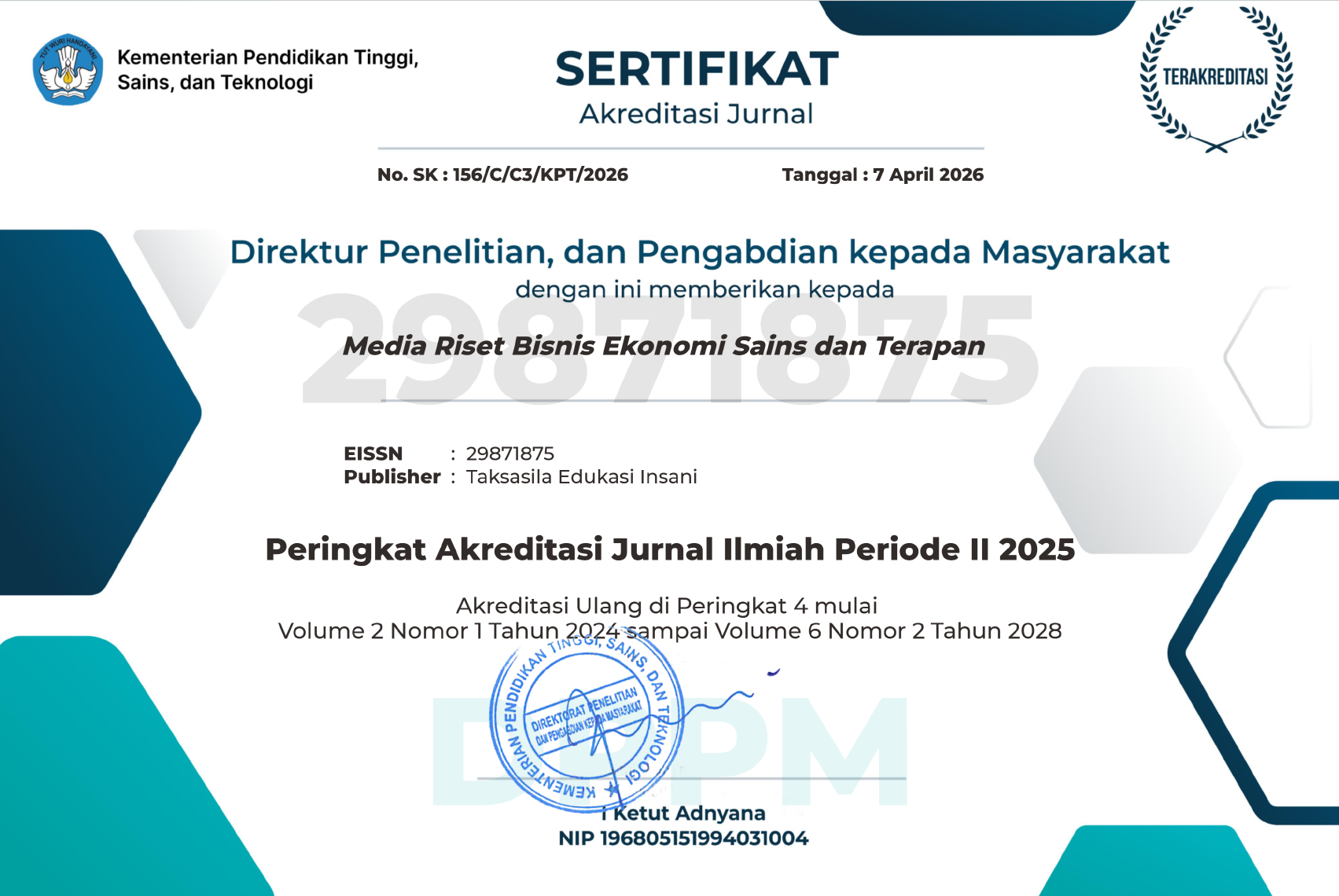
Media Riset Bisnis Ekonomi Sains dan Terapan (MRBEST) Indexed by:




Publisher: Taksasila Edukasi Insani
Contact: Tri Ananto
Publisher Address: Jl. Cireundeu Raya No.1A, RT.002/RW.06, Kelurahan Cireundeu, Kecamatan Ciputat Timur, Kota Tangerang Selatan, Banten 15419.
Copyright © 2023 Media Riset Bisnis Ekonomi Sains dan Terapan (e-ISSN: 2987-1875)


Media Riset Bisnis Ekonomi Sains dan Terapan © 2023 by Taksasila Edukasi Insani is licensed under Creative Commons Attribution-ShareAlike 4.0 International.